New Perspectives on Race and Slavery in America by Robert H. Abzug Stephen E. Maizlish
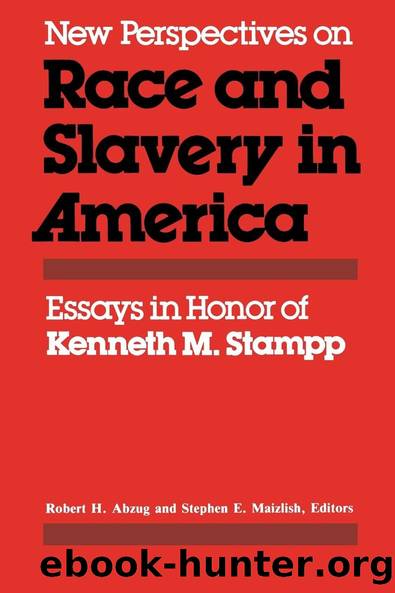
Author:Robert H. Abzug, Stephen E. Maizlish [Robert H. Abzug, Stephen E. Maizlish]
Language: eng
Format: epub
Tags: History, General
ISBN: 9780813115719
Google: AYj_ILnRhfUC
Publisher: University Press of Kentucky
Published: 1986-01-01T02:50:58+00:00
I thank Robert Abzug, Robby Cohen, E.D. Mitchell, Martha Reiner, Charles Sellers, Nina Silber, and Harry Watson for their help.
1. For Lieutenant Polkâs biography, see Stuart Noblin, Leonidas Lafayette Polk: Agrarian Crusader (Chapel Hill, 1949); for Polkâs Civil War service see the L. L. Polk Papers, Southern Historical Collection, University of North Carolina, Chapel Hill, specifically his letters to his wife, Jan. 29, March 9, March 21, March 26, April 19, and July 23, 1863.
2. It is a common assumption, for example, that one advantage possessed by the Confederate army during the war was the fact that southern officers were used to command and that southern soldiers, trained by a pervasive class-and-caste system, were used to obedience. A recent and very explicit example of these attitudes is to be found in William L. Barneyâs Flawed Victory (New York, 1979). Barney describes Confederate officers as âmembers of a master class,â accustomed to deference from both blacks and poor whites. Emory Thomas comments on the deference shown by poorer whites to their social betters in The Confederate Nation (New York, 1979) and argues that while planter hegemony was challenged during the war it emerged relatively unscathed. These are far from being the only historians who accept what might be called âthe barbecue theory of social control,â according to which the wealthy maintained their power by throwing an occasional sop to their poor kinsmen and neighbors. This interpretation of the antebellum South, which has developed hegemonic status of its own in the profession, is now being challenged by the growing body of literature dealing with antebellum politics and the role of the small slaveholder and the nonslaveholder in the South. Among these works are James Oakes, The Ruling Race (New York, 1982), Harry Watson, Jacksonian Politics and Community Conflict (Baton Rouge, 1981), and J. Mills Thornton III, Politics and Power in a Slave Society (Baton Rouge, 1978). The truth of the matter is that in a society as fluid as the antebellum South, there was sufficient possibility for upward mobility that even nonslaveholders might expect to own slaves sometime in the futureâthus non-slaveholder support of slavery is perfectly rational if deplorable. After all, Thomas Sutpen, William Faulknerâs embodiment of the Old South in Absalom, Absalom!, is the son of poor whites.
3. Michael P. Johnson, Toward a Patriarchal Republic: The Secession of Georgia (Baton Rouge, 1977), 63; Steven A. Channing, Crisis of Fear: Secession in South Carolina (New York, 1970), 155.
4. For a discussion of the economy of the Old South, see Gavin Wright, The Political Economy of the Cotton South: Households, Markets, and Wealth in the Nineteenth Century (New York, 1978). For the premarket sector, James A. Henretta, âFamilies and Farms: Mentalitie in Pre-Industrial America,â William and Mary Quarterly 35 (Jan. 1978): 3-32; Michael Merrill, âCash is Good to Eat: Self-Sufficiency and Exchange in the Rural Economy of the United States,â Radical History Review 4 (Winter 1977): 42-71; Gavin Wright and Howard Kunreuther, âCotton, Corn, and Risk in the Nineteenth Century,â Journal of Economic History 35 (Sept.
Download
This site does not store any files on its server. We only index and link to content provided by other sites. Please contact the content providers to delete copyright contents if any and email us, we'll remove relevant links or contents immediately.
Cecilia; Or, Memoirs of an Heiress — Volume 1 by Fanny Burney(32562)
The Great Music City by Andrea Baker(32023)
Cecilia; Or, Memoirs of an Heiress — Volume 2 by Fanny Burney(31959)
Cecilia; Or, Memoirs of an Heiress — Volume 3 by Fanny Burney(31945)
We're Going to Need More Wine by Gabrielle Union(19052)
All the Missing Girls by Megan Miranda(16049)
Pimp by Iceberg Slim(14522)
For the Love of Europe by Rick Steves(14166)
Bombshells: Glamour Girls of a Lifetime by Sullivan Steve(14081)
Norse Mythology by Gaiman Neil(13376)
Talking to Strangers by Malcolm Gladwell(13376)
Fifty Shades Freed by E L James(13247)
Mindhunter: Inside the FBI's Elite Serial Crime Unit by John E. Douglas & Mark Olshaker(9347)
Crazy Rich Asians by Kevin Kwan(9297)
The Lost Art of Listening by Michael P. Nichols(7508)
Enlightenment Now: The Case for Reason, Science, Humanism, and Progress by Steven Pinker(7316)
The Four Agreements by Don Miguel Ruiz(6770)
Bad Blood by John Carreyrou(6626)
Weapons of Math Destruction by Cathy O'Neil(6284)
